
A self-employed personal trainer runs a small business, not just sessions. First, choose how you work: rent gym space, take paid gym hours, or train clients at home or online. Then sell blocks of sessions, charge up front and price from your real hourly rate. Finally, register with HMRC and keep your records.
That sounds like a lot. However, you do most of it once, at the start. So this guide covers the business side, one step at a time. It also links to deeper guides.
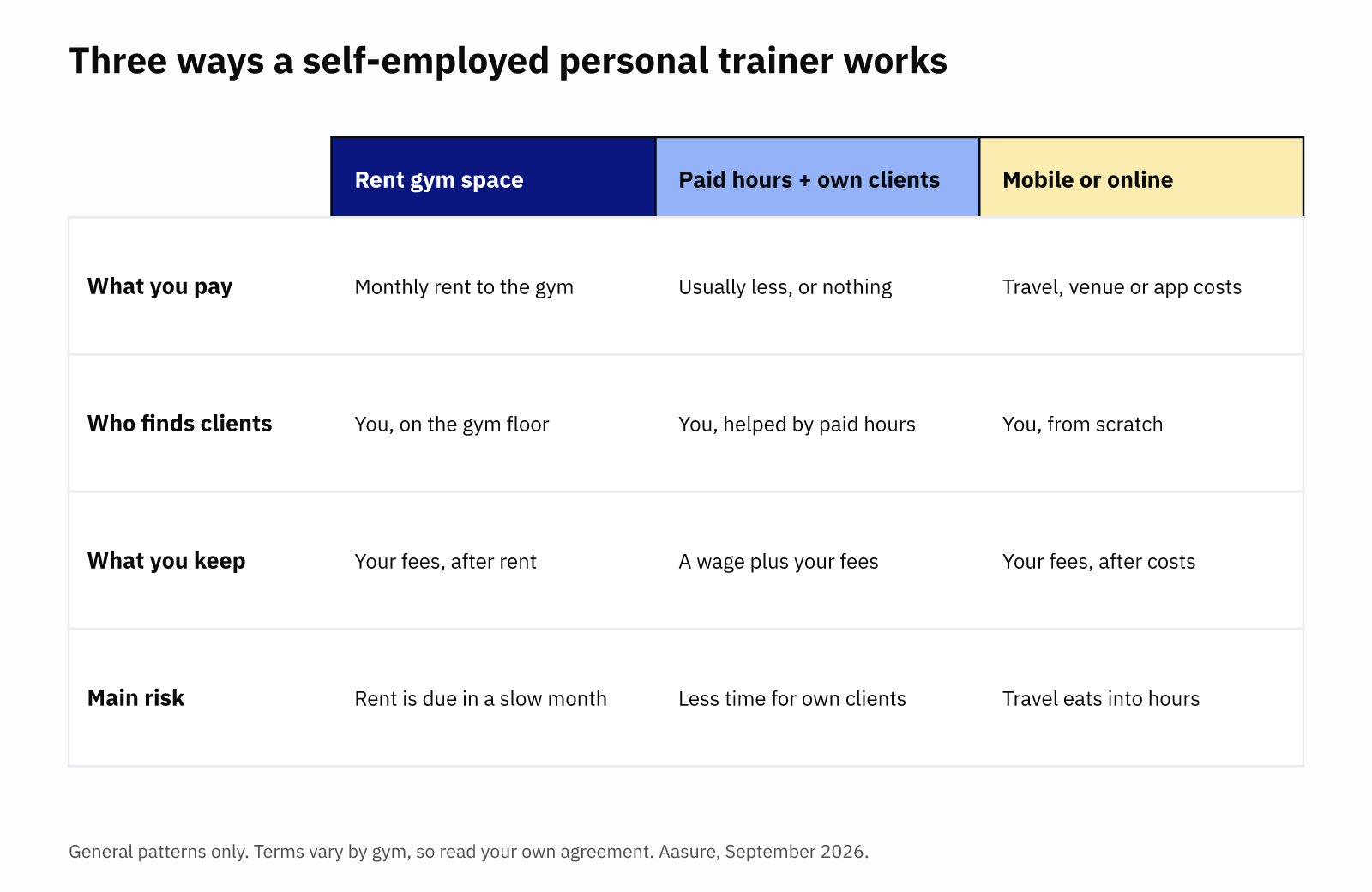
Three ways to work as a self-employed personal trainer
Most trainers start in one of three set-ups. Each one changes your costs, your risk and how you find clients.
Renting gym space. You pay the gym a monthly fee, then keep what your clients pay you. For example, PureGym says its self-employed trainers keep 100% of their earnings and get their first month's rent free. For a self-employed personal trainer, the upside is a floor full of potential clients. The downside is that rent is due even in a quiet January.
Paid hours plus your own clients. Some gyms pay you for set hours on the floor, then let you train your own clients. PureGym's Fitness Coach role, for instance, pays a contracted salary for 12 hours a week. As a result, you have some steady income while your client list grows.
Mobile or online. You train people at home, in parks or on video. There is no rent, but travel time is unpaid time. So price for it, or group your clients by area.
Whichever you choose, check you really are a self-employed personal trainer. GOV.UK says you are probably self-employed if you send invoices and pay your own tax. Another sign is getting no holiday or sick pay. If a gym controls your hours, prices and clients, however, you may really be a worker. In that case, ask the gym to explain the contract before you sign.
A full diary starts with the people already near you
As a self-employed personal trainer, your first clients rarely come from ads. Instead, they come from the gym floor, from friends of clients, and from people who search nearby.
Start where people already train. On a rented-space deal, time on the floor is your marketing. So say hello, fix a squat and offer a free check-in. Meanwhile, ask every happy client for one introduction. A referral arrives already trusting you.
Next, set up a free Google Business Profile, so you appear when locals search for a trainer. Add your area, your prices and a booking link. Then ask clients for reviews after good sessions, not on day one.
Keeping clients matters as much as finding them, though. For a self-employed personal trainer, a client who stays a year is worth more than three who try a month. So learn the five warning signs a PT client is about to cancel, and act early. For ideas while you drive between sessions, try these personal trainer podcasts for coaches.
Finally, keep your professional status current. CIMSPA's personal trainer membership costs £38.94 a year and requires 10 points of CPD. It also gives clients and gyms a way to check your standing.
We ask you to complete CPD every year to ensure that your professional knowledge remains up to date and relevant.
Session packages and block bookings keep the diary steady
Single sessions make a self-employed personal trainer's income lumpy. By contrast, a block of 10 or 12 sessions books you weeks ahead. It also commits the client to turning up.
A simple package menu works best. For example:
- A starter block: six sessions over three weeks, to build the habit.
- A standard block: 10 or 12 sessions, used within a set number of weeks.
- A monthly plan: a fixed number of sessions each month, paid on the same date.
Give every block an expiry date, and write it down. Otherwise, clients let sessions drift for months. Also, book the whole block into fixed weekly slots when the client buys. That way, "Tuesday at 7am" becomes part of the client's week, not a fresh decision each time.
Then, when a block has two sessions left, talk about the next one. That way, the renewal happens before the gap, not after it. A self-employed personal trainer can track blocks in a spreadsheet at first. However, it gets messy past 15 or so clients, so compare personal trainer software built for this.
Price from your real hourly rate, not the local going rate
As a self-employed personal trainer, you might copy the price down the road. But the other trainer may have lower rent, fewer unpaid hours or a partner's wage behind them. So work out what one hour of your week truly pays.
Here is an illustrative week. You teach 20 sessions at £45, so you take £900. However, you also spend about 12 unpaid hours on programming, messages, travel and marketing. Costs come off too: £175 of rent, £25 of insurance and kit, and card fees.
Card fees are small but real. Stripe, for example, charges 1.5% + 20p for standard UK cards, which is about 88p on a £45 session. Across 20 sessions, that adds up to £17.50.
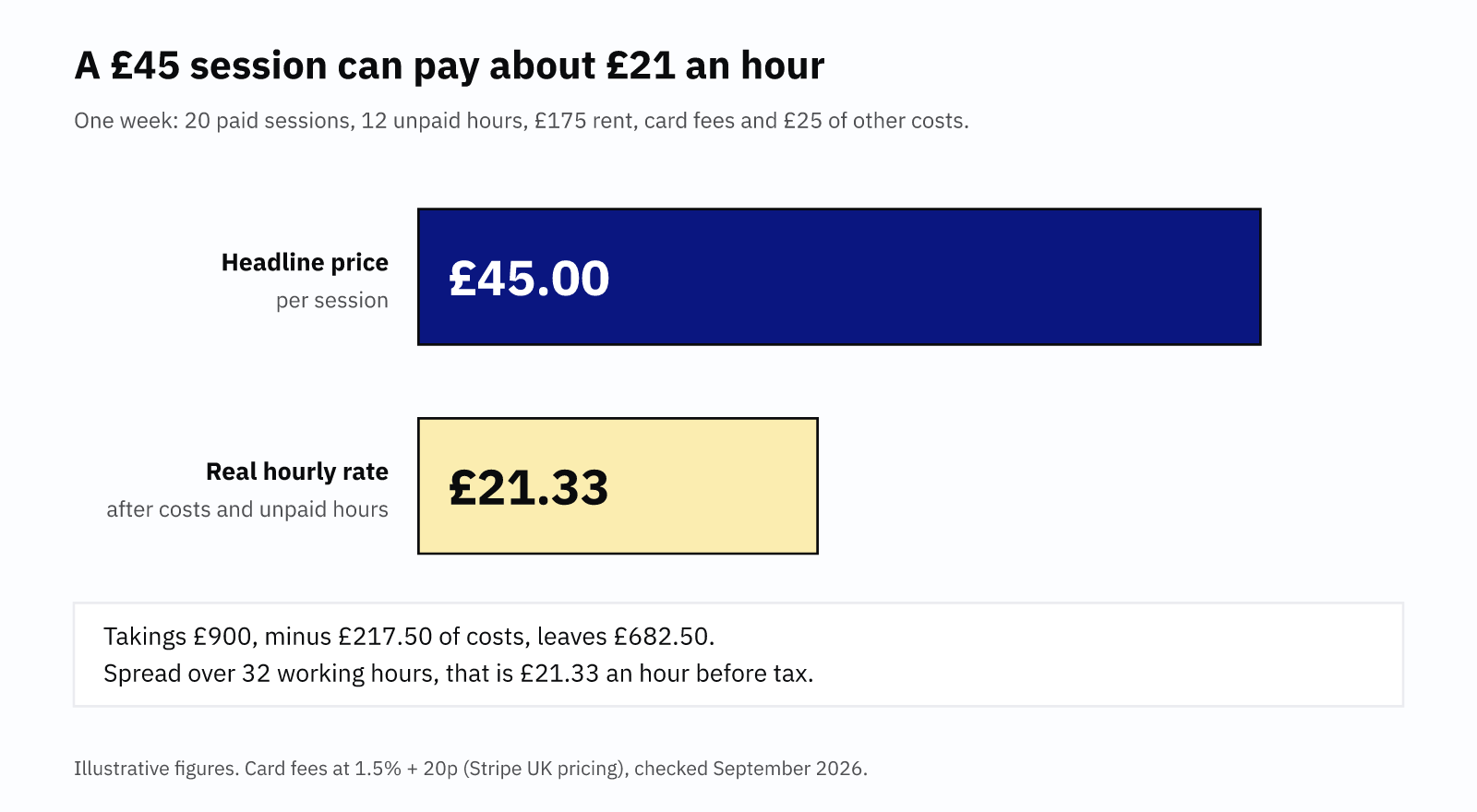
In this example, you keep £682.50 for 32 hours of work. That is £21.33 an hour, before tax. In other words, your £45 rate pays less than half of what it seems. For the full method, read what your real hourly rate is as a personal trainer. Then, as a self-employed personal trainer, set your price so the real rate covers your bills, holidays and pension.
Cancellations and up-front payment protect your income
A late cancellation costs a self-employed personal trainer the full session fee. You cannot resell a 7am slot at 6:30am. So you need a clear rule, and you need to apply it every time.
First, write a cancellation policy with a clear notice window, such as 24 hours. A late cancel or no-show then uses up a session from the block. Our guide to writing a personal trainer cancellation policy has wording you can adapt. To see what missed sessions already cost you, try the no-show cost calculator.
Next, take payment before the session, not after. When a client pays for a block up front, a late cancel simply comes off their balance. As a result, there is no awkward chat and no invoice to chase. Card payment at booking also means you never ask for money in the middle of a gym.
Finally, show the policy at the moment of booking. That way, no client can say they never saw it.
HMRC tax basics for a self-employed personal trainer
Tax feels scary for a new self-employed personal trainer, but the basics are simple. Register, keep records, then file one return a year.
Register. You must send a tax return if you earned more than £1,000 as a sole trader, before expenses. Then you tell HMRC by 5 October after the tax year you started. After that, you file online and pay by 31 January.
Know what you pay. In 2026/27, Income Tax is 20% on income from £12,571 to £50,270. On top of that, you pay Class 4 National Insurance of 6% on profits over £12,570. Above £50,270, the Class 4 rate drops to 2%. Class 2 no longer needs paying if profits are £7,105 or more. Instead, HMRC treats it as paid. Scotland, however, sets its own Income Tax rates.
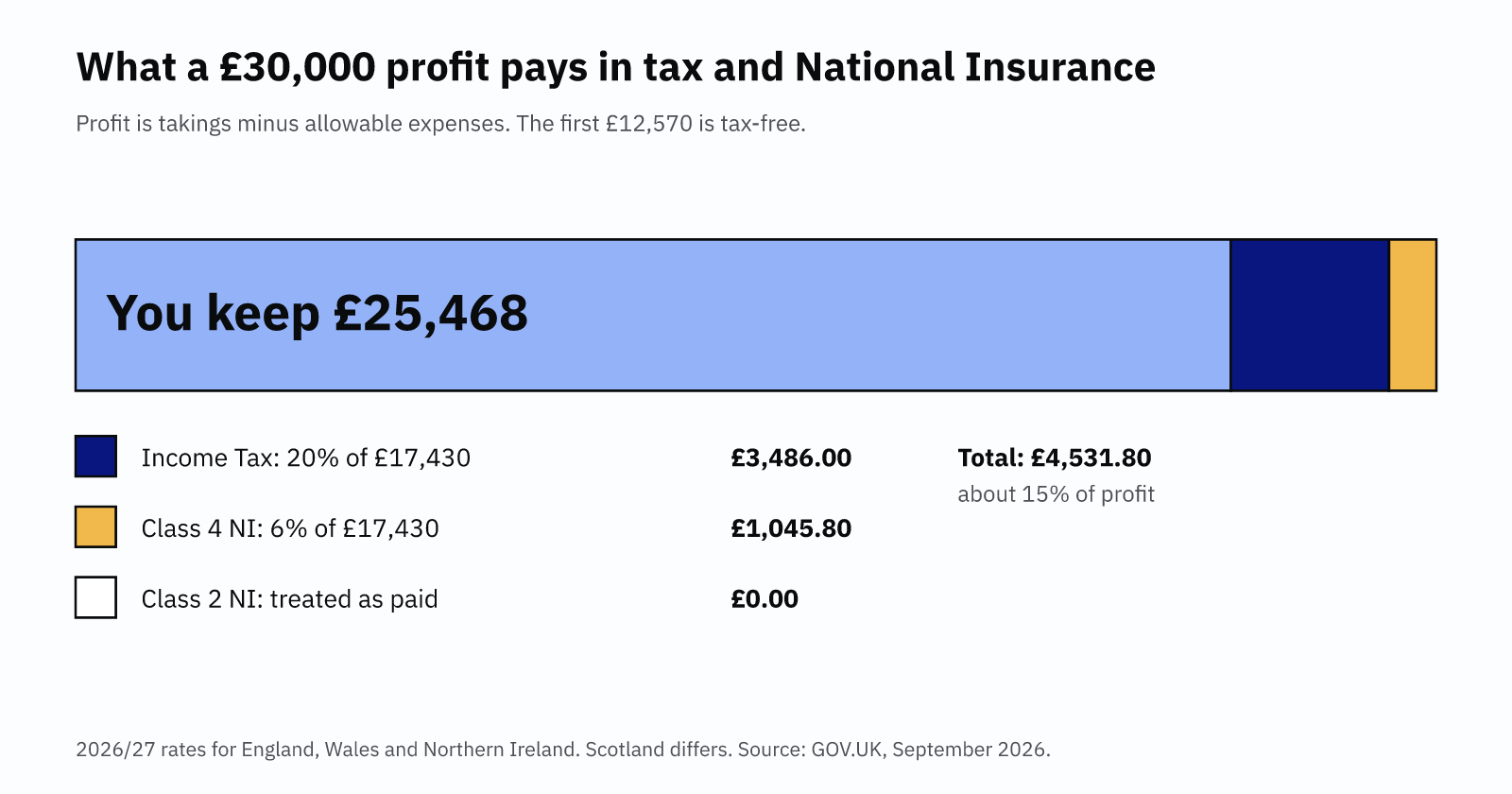
Plan for payments on account. Once your bill passes £1,000, HMRC asks you to pay towards next year's bill in advance. Each payment is half of last year's tax. So your first January bill can be much bigger than you expect. So, as a self-employed personal trainer, put aside about a fifth of your profit each month.
Allowable expenses a self-employed personal trainer can claim
Expenses lower your profit, so they lower your tax. HMRC lists the allowable expenses for self-employed people. For a self-employed personal trainer, they usually include:
- gym rent and insurance
- equipment such as bands, kettlebells and a heart rate monitor
- phone bills, booking software and your website
- refresher courses and CPD that improve the skills you already use
- business mileage at 55p a mile for the first 10,000 miles in 2026/27
Two traps catch trainers out. First, everyday clothing does not count, even if you only wear it to train people. A uniform does. Second, you cannot claim expenses if you use the £1,000 trading allowance instead. So pick whichever saves more.
Also, keep every receipt. GOV.UK says you must keep records for at least five years after the 31 January deadline.
Making Tax Digital reaches most full-time trainers from 2027
Making Tax Digital changes how you report, not what you pay. You keep digital records and send HMRC a short update every three months.
From 6 April 2027, it covers sole traders with qualifying income over £30,000. Crucially, HMRC counts income before expenses, also called turnover. Then, from April 2028, the line falls to £20,000.
That catches a typical full-time self-employed personal trainer. For example, 20 sessions a week at £45, across 46 weeks, is £41,400 of takings. So you would be in, even with a much smaller profit.
Our guide to Making Tax Digital for sole traders covers the deadlines, the penalties and the software rules. Meanwhile, the free MTD Readiness Quiz gives you a start date in about two minutes. Note that a booking app on its own does not file with HMRC. You still need software that HMRC recognises.
This guide gives general information, not personal tax advice. For a tricky case, check GOV.UK or ask an accountant. And for how booking and client records fit together, see how Aasure works for personal trainers. Session blocks are coming soon.
Common questions
Do I need to register as self-employed to be a personal trainer?
Under HMRC rules, yes, if you work for yourself and take over £1,000 in a tax year. That figure is before expenses. You must tell HMRC by 5 October after the tax year you started. So if you started in summer 2026, the deadline is 5 October 2027.
How much tax does a self-employed personal trainer pay?
It depends on profit, not takings. At HMRC's 2026/27 rates, the first £12,570 is tax-free. After that, you pay 20% Income Tax and 6% Class 4 National Insurance on basic-rate profit. So a £30,000 profit costs about £4,532. Scotland has different Income Tax rates.
Can a personal trainer claim gym clothes as an expense?
Usually not. HMRC does not allow everyday clothing, even if you only wear it for work. However, a uniform counts, such as branded kit. You can also claim gym rent, insurance, travel, equipment and refresher courses. Keep receipts for at least five years after the filing deadline.
Does Making Tax Digital apply to personal trainers?
Yes, once your takings pass the threshold. From 6 April 2027, it covers sole traders taking over £30,000 a year. HMRC counts takings before expenses, not profit. Then, from April 2028, the line falls to £20,000. So most full-time trainers will be in scope soon.
Find your real hourly rate.
The free Real Hourly Rate Calculator counts your unpaid hours, travel and costs. It shows what each session truly pays, so you can set prices with confidence.
Work out your rate