Making Tax Digital is HMRC's new way of collecting Income Tax from sole traders. Instead of one tax return a year, you keep digital records and send a short update every three months. It has applied above £50,000 since April 2026. From 6 April 2027, the line drops to £30,000 of yearly takings.
That second date matters to a lot of small service businesses. A full-time stylist, personal trainer or tutor can easily take £30,000 in a year. So if that sounds like you, Making Tax Digital probably reaches you next spring. The good news is that the work is smaller than it sounds. This guide explains who is in, what you send, and what to do before April.
Who Making Tax Digital covers, and when
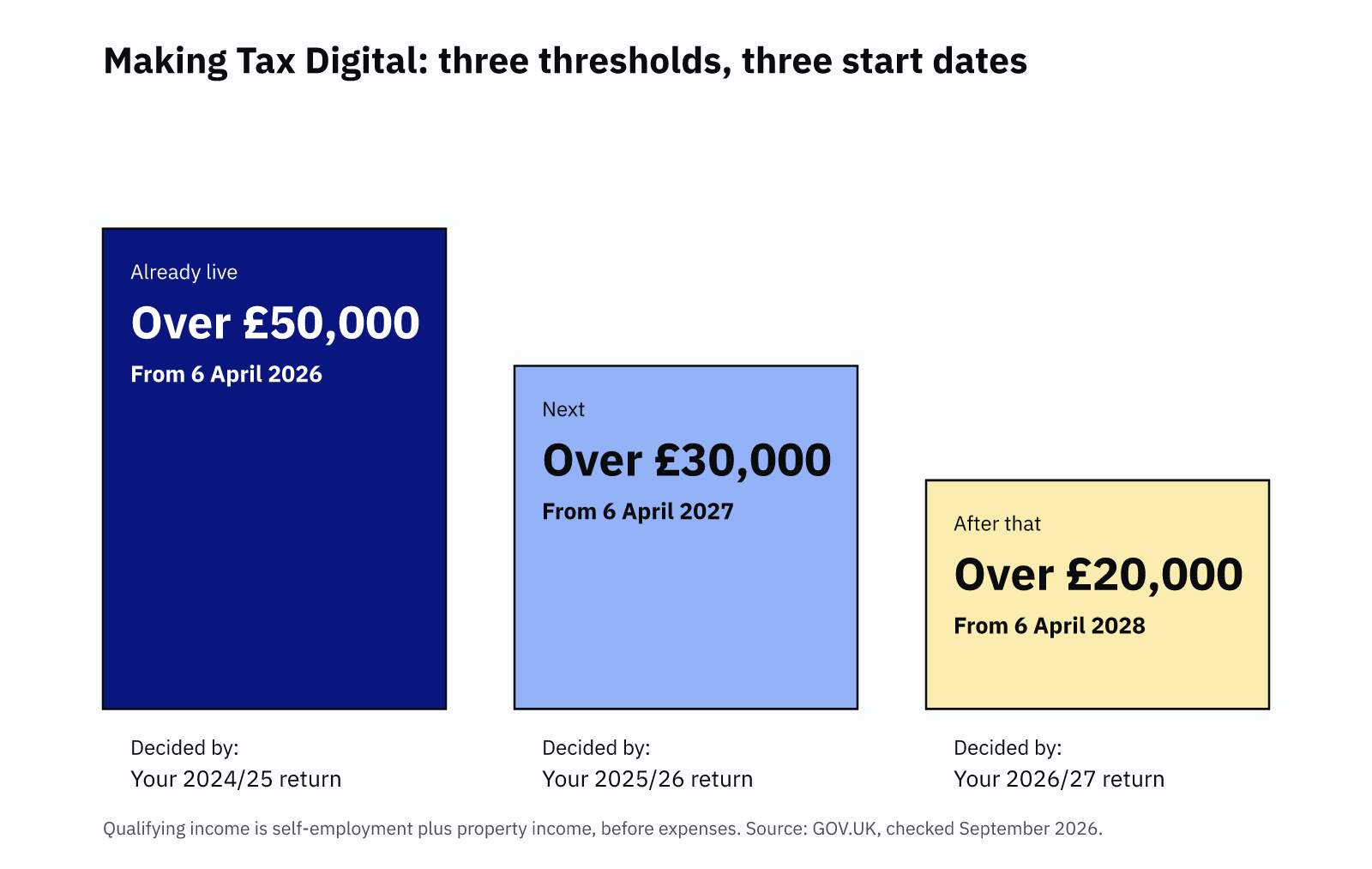
Making Tax Digital for Income Tax applies to you if two things are true. First, you are a sole trader or landlord registered for Self Assessment. Second, your qualifying income is over the threshold. GOV.UK sets out three stages:
- Over £50,000: from 6 April 2026, based on your 2024/25 tax return
- Over £30,000: from 6 April 2027, based on your 2025/26 tax return
- Over £20,000: from 6 April 2028, based on your 2026/27 tax return
Notice the gap between the return and the start date. HMRC looks back at an earlier year to decide. So the return you file by 31 January 2027 decides whether you start in April 2027. In other words, what you took between April 2025 and April 2026 has already settled it.
The first group was large. According to HMRC, 864,000 sole traders and landlords were in scope from April 2026. The £30,000 stage of Making Tax Digital adds many more, because lots of businesses sit between £30,000 and £50,000.
Some people can ask for an exemption. For example, you may qualify for one if you are digitally excluded. That means something like age, disability or location stops you using software. You apply for it through GOV.UK.
Takings count, not profit
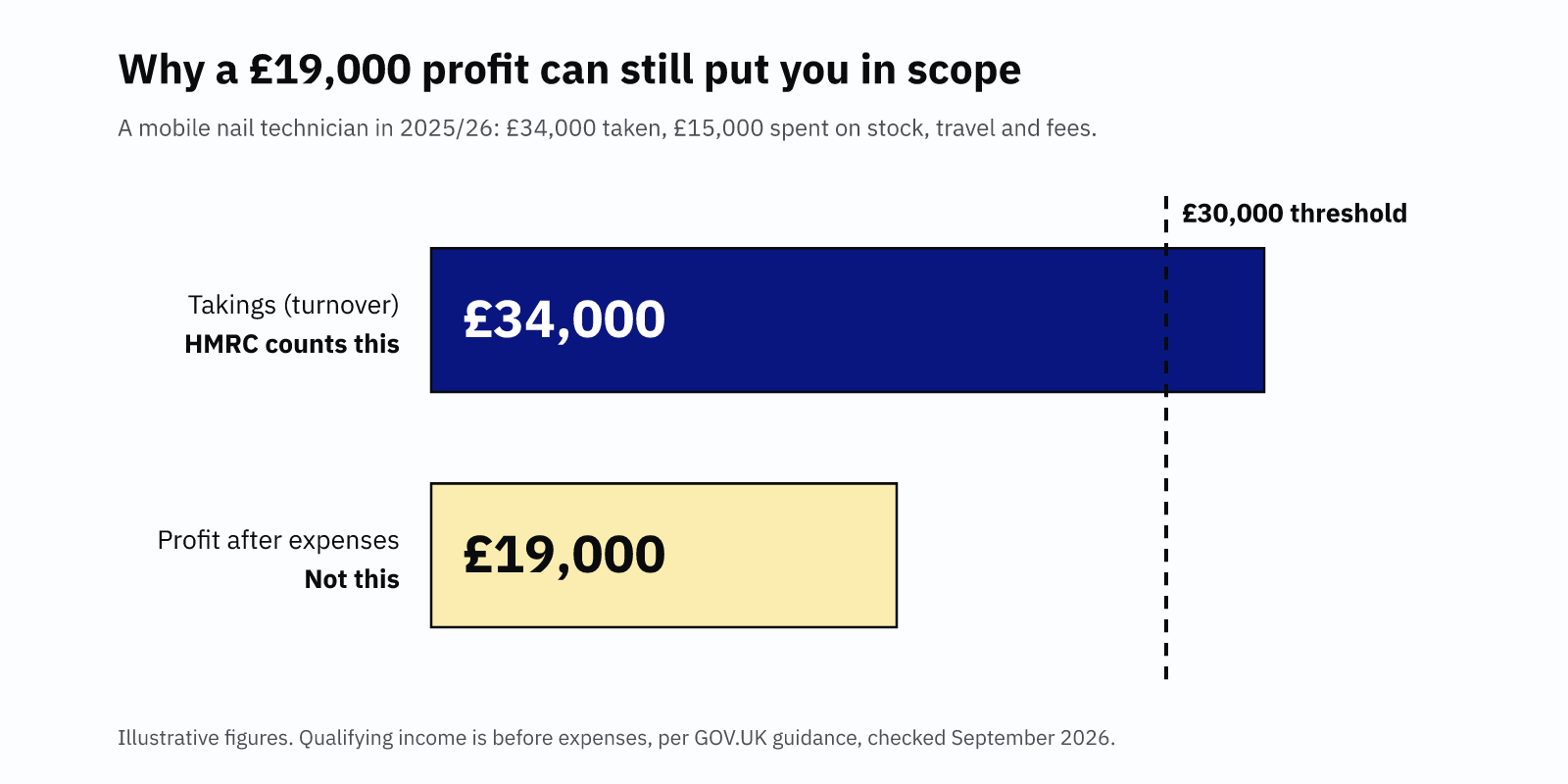
This is the part most people get wrong. For Making Tax Digital, qualifying income is your total income from self-employment and property before expenses. HMRC's own wording is plain: it is "the amount before expenses (also known as turnover)".
That hits service businesses hard, because many have high running costs. Take a mobile nail technician. They take £34,000 in a year. Then they spend £15,000 on stock, fuel, insurance and fees. Their profit is only £19,000. Even so, they are over the £30,000 line and join in April 2027.
Some income does not count at all. HMRC leaves out wages from a PAYE job. It also leaves out dividends, pensions and your share of a partnership. As a result, someone with a part-time job and a side business only counts the side business.
Rent works the other way. If you let a room or a flat, add that rent to your self-employed takings. GOV.UK's own example adds £25,000 of rent to £27,000 of self-employment. That makes £52,000, which is over the first threshold.
What a quarterly update actually is
A Making Tax Digital quarterly update sounds like a mini tax return. In practice it is much simpler. It is a running total of your income and expenses for the year so far, grouped into categories. HMRC also confirms it does not receive your individual receipts or invoices. You still keep those yourself, digitally.
You do not pay tax with each update, either. HMRC says the new system "won't change the way you pay Income Tax" or the dates you pay it. Instead, the updates give you an early view of what you might owe. That alone can stop a nasty surprise in January.
At the end of the year, you still submit a tax return by 31 January. However, your Making Tax Digital software builds most of it from the four updates. So there is far less to type in at the end.
The four Making Tax Digital deadlines in a year
Every quarterly update has a fixed deadline. For the standard periods, GOV.UK lists these dates:
| Update covers | Send it by |
|---|---|
| 6 April to 5 July | 7 August |
| 6 April to 5 October | 7 November |
| 6 April to 5 January | 7 February |
| 6 April to 5 April | 7 May |
Every period starts on 6 April. That is because each update covers the year so far, not just the latest three months. You can also choose calendar quarters, which end on the last day of a month. However, the deadlines stay the same. Also, you cannot change periods once you have sent an update that year.
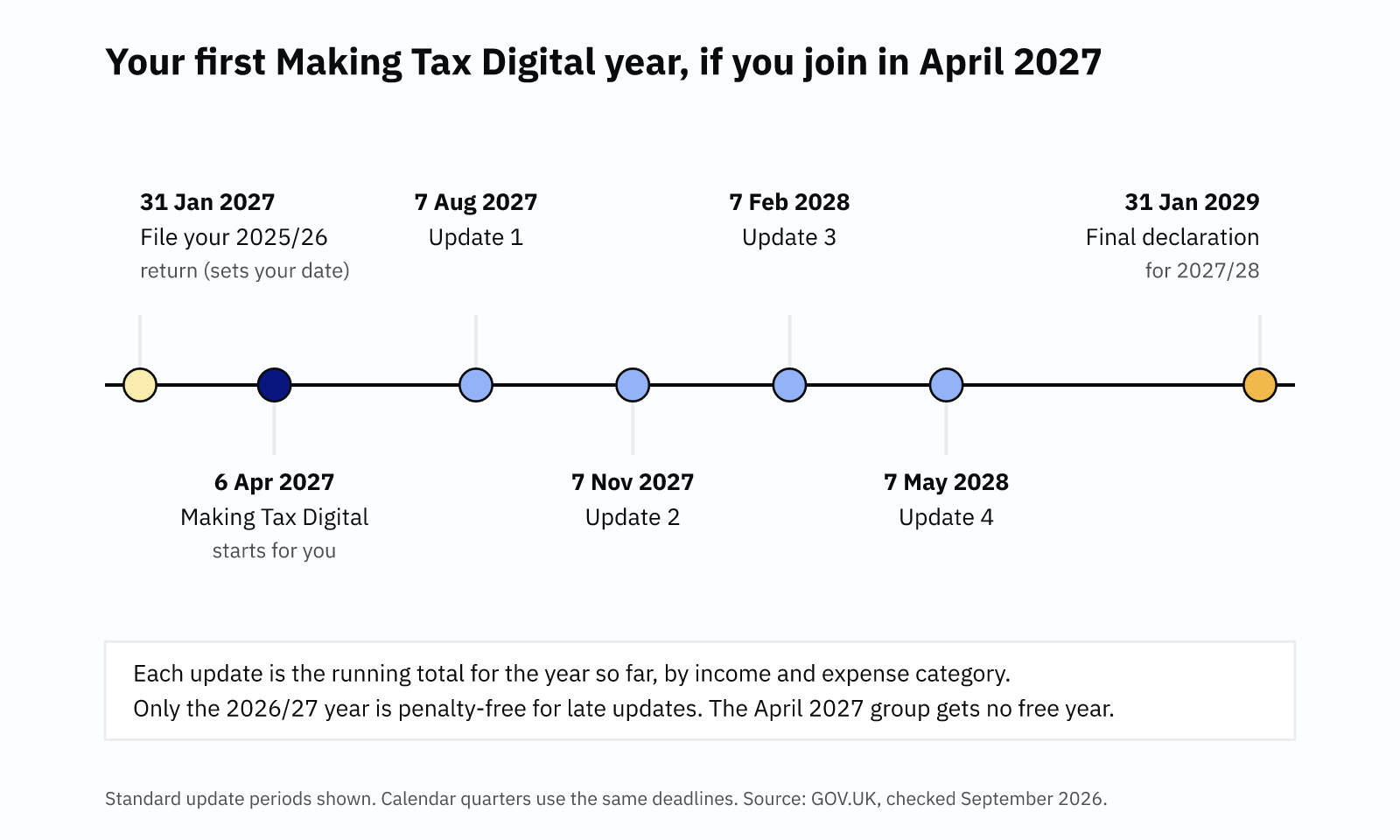
So for the April 2027 group, the first deadline is 7 August 2027. The tax return for that year is then due by 31 January 2029.
Penalties: no free year for the 2027 group
The Making Tax Digital penalty system uses points, a bit like a driving licence. You get one point for each missed deadline. Once you reach four points, you pay a £200 penalty. After that, every further missed deadline costs another £200.
The first group got a soft start. GOV.UK says there are no penalties for a missed quarterly update in the 2026 to 2027 tax year. But that relief names one tax year only. HMRC's own announcement says penalties begin from 6 April 2027. So if you join in April 2027, late updates count from your very first deadline.
Late payment is a separate matter. If you pay your tax late, percentage charges and interest apply on top. The same penalty page sets out those rates.
The first group also shows how easy it is to slip. By the first deadline on 7 August 2026, 436,000 people had sent an update. That is roughly half of the 864,000 in scope. Even so, HMRC welcomed the start.
It's fantastic to see so many sole traders and landlords successfully sending their first quarterly updates. This marks an important milestone in the move to a more modern tax system.
Making Tax Digital software: what counts
You must use software that works with Making Tax Digital. It has to keep your digital records and send your updates to HMRC. Private companies make this software, and HMRC checks it. To choose one, use HMRC's software finder, which filters products to match your situation.
There are three broad types:
- Bookkeeping apps. These keep records, sort expenses and send updates in one place.
- Bridging software. This links your existing spreadsheet to HMRC, so you can keep the sheet you know.
- Free products. GOV.UK says these exist for people with simple tax affairs, although some have limits.
A booking system on its own is usually not enough. For example, your booking app may hold every payment you take. But unless it can send updates to HMRC, it does not meet the Making Tax Digital rules. Aasure is in that position too. It records your bookings and the payments you log, but it does not file with HMRC. Making Tax Digital support is on the way, but it is not live yet. So check any tool against the finder before you rely on it.
What to do now if April 2027 is your date
You have about six months. That is plenty of time, as long as you start this autumn. Not sure of your date? Our free MTD Readiness Quiz works it out in two minutes. Then follow this plan.
- Check your 2025/26 takings. Add self-employment and rental income before expenses. Over £30,000 means you are in.
- File your 2025/26 return early. It is due by 31 January 2027, and it sets your start date.
- Pick your software. Use HMRC's finder, then try free trials before April.
- Practise this winter. Log income and costs in the new software now. A trial run costs nothing.
- Sign up yourself. Do it before HMRC does it for you.
- Diarise the deadlines. Add 7 August, 7 November, 7 February and 7 May.
Why sign up yourself? HMRC began signing people up for Making Tax Digital in September 2026. But when HMRC does it, it only uses the details it already holds. If you do it yourself, you can check that everything is right.
Also, keep claiming your costs. Software, stock and travel are still allowable expenses, including the software you buy for this. Meanwhile, if admin already eats your evenings, see the admin jobs UK owners would give up first. And to see what you truly earn after costs, work out your real hourly rate.
This guide gives general information, not personal tax advice. For a tricky case, check GOV.UK or ask an accountant.
Common questions
Does Making Tax Digital apply if I take under £30,000?
Not in April 2027. However, the threshold falls to £20,000 from 6 April 2028, based on your 2026/27 return. Below £20,000, HMRC requires nothing yet. You can still sign up early by choice. That gives you a practice run before the rules reach you.
Is the £30,000 threshold based on profit or turnover?
Turnover. HMRC counts your self-employment and property income before expenses. So a business taking £34,000 with £19,000 profit is still over the line. Wages from a PAYE job, dividends and pensions do not count towards it.
Do I still file a tax return under Making Tax Digital?
Yes. You still submit a tax return by 31 January. However, your software builds most of it from your four quarterly updates. The way you pay Income Tax does not change either. The payment deadline is still 31 January.
What happens if I miss a quarterly update?
You get one penalty point per missed deadline. At four points, HMRC charges a £200 penalty, then £200 for each further miss. Late updates for 2026/27 carry no penalty. That relief covers one tax year only, so the April 2027 group gets no free year.
Find your Making Tax Digital start date.
The free MTD Readiness Quiz takes about two minutes. It uses HMRC's published thresholds to give you a start date and a readiness score. General information, not tax advice.
Take the quiz