
A hairdresser price increase works when your chair is busy, your sums are done and clients hear about it early. Raise most prices by 5 to 10% and start with your busiest services. Then give written notice before the new price starts. Fresha's guide for hair professionals suggests raising prices by 5 to 10% on your most in-demand services. The six steps below show how to decide, how to tell clients and what to say when someone objects.
Step 1: Check your diary before a hairdresser price increase
Raise prices when demand is already there. DaySmart's salon guide is blunt: "do not increase prices if you are not booked out for weeks". It adds that below 80% capacity, it may pay to spend more time finding clients first. DaySmart is a US software firm, so treat the dollar figures in its guide as a guide only.
Fresha names the opposite trap. Fully booked but still struggling? That is, in its words, usually a clear indicator that you need to increase your prices. So look at two numbers: how full the diary is, and what is left after costs.
Step 2: Know your costs before you pick a number
A price rise should follow your costs, not your nerves. Fresha's rule is simple: each service should cover your expenses and a little extra profit. That means you need a cost per service before you choose a figure. Our guide to your real hourly rate shows the sum.
Three outside numbers are worth checking this month:
- Wages. The National Living Wage for ages 21 and over is £12.71 an hour from April 2026. If you employ juniors, that moves your cost per service.
- Inflation. The ONS reports CPI at 3.1% in the 12 months to August 2026. That is a general figure, not a hairdressing one. Even so, a 3% rise only keeps you level.
- VAT. You must register if your taxable turnover goes over £90,000 in any 12 months. A rise on a busy diary can push you towards that line.
You are not alone in feeling the squeeze. The National Hair & Beauty Federation's 2026 survey covered 423 professionals. Nearly three quarters said they run on thin margins, and 307 expect to raise prices. One in five said they run at a loss.
Step 3: Choose the size of your hairdresser price increase
Small and regular beats big and rare. Hairdressers Journal International published tips from Matrix artist Terry Longden. They say that "smaller percentage rises are easier and less shocking to clients". The same piece gives a quick check: 5% adds £5 to a £100 bill, and 10% adds £10.
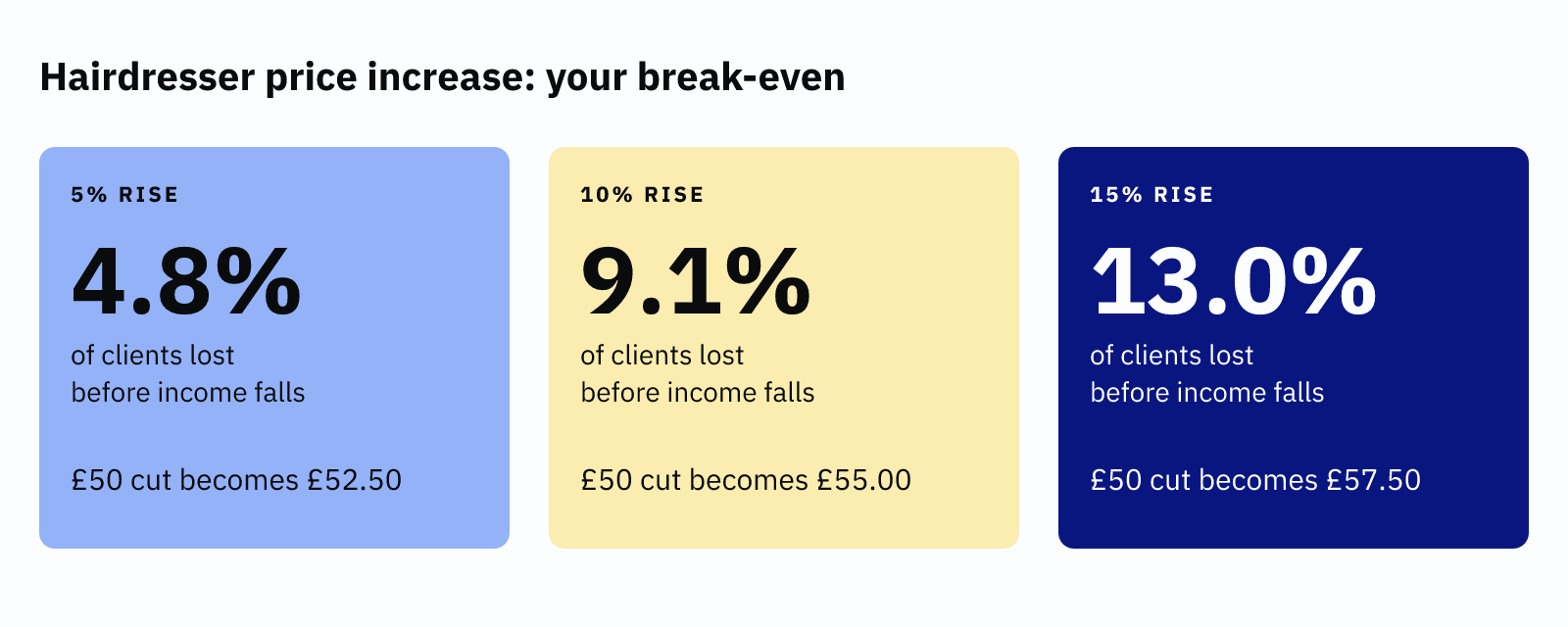
So how many clients can you lose before the rise costs you money? Say the price rises by a share r. Then you break even when you lose r ÷ (1 + r) of your clients. This is our own arithmetic, and it ignores costs that fall when you do less work.
| Price rise | Clients you can lose before income falls | A £50 cut becomes |
|---|---|---|
| 5% | 4.8% | £52.50 |
| 10% | 9.1% | £55.00 |
| 15% | 13.0% | £57.50 |
Here is a worked example. Say you cut 25 clients a week at £50, which is £1,250. After a 10% rise you lose two of them. You then see 23 clients at £55, which is £1,265. You earn slightly more for two fewer hours of work.
That is an illustration, not a forecast. Your own list of regulars decides the real result.
Step 4: Raise your busiest services first
Start where demand is strongest. DaySmart suggests you look to increase prices in your area of expertise. If colour is booked for weeks and cuts are not, raise colour first. Fresha adds a second tip. It suggests testing the change on new clients before you roll it out to regulars.
Then show the new prices everywhere at once. Update your price list, your booking page and your social bios on the same day. The CMA says it is illegal to hide mandatory fees until late in the purchase process. So put the full price on the list and add no surprise extras at the till.
Step 5: Tell clients early, in writing
Give notice and give a reason. Fresha's advice is to let clients know in advance and explain the reasons behind the increase. Longden's tips say the same: explain the rise as a goal to continue to create a professional and safe environment.
Neither source sets a notice period. Four to six weeks is our own suggestion, because it covers most clients' next visit. Send the message by email, then repeat it when the client rebooks.
Hi [Name], a quick heads-up. From [date], my [service] will be £[new price] instead of £[old price]. My costs have gone up across the board, and I want to keep giving you the best work I can. Your booking on [existing date] stays at the old price. If you have any questions, just reply to this email.
Replace the brackets with your own details. Only promise the old price on bookings you have already confirmed if you mean it. Our rebooking scripts for hairdressers include lines for the chair, when the client is standing in front of you.
Step 6: Handle pushback without apologising
Some clients will object, and that is normal. Keep your answer short, kind and fixed. The same HJI piece has a tip for objections. You can introduce the client to a colleague in your salon who charges less. That keeps the client in the salon and frees your time for new clients.
If you work alone, offer a shorter service at a lower price instead. Do not discount the full service for one client. Others will hear about it. Next, fill the gaps. A salon waitlist can offer freed slots to clients who already want one.
Where a booking tool helps with a hairdresser price increase
A booking tool does not set your prices. It can make the change easier to run. Aasure gives you a branded booking page and a website that you edit and publish yourself. So you can update what clients see in one go. Client records and segments help you find the people to tell. Email campaigns let you send the notice. It sends email only, not text or WhatsApp, and card payments and deposits are coming soon. If you are still comparing tools, our guide to the best salon software is a good place to start.
This week, do steps 1 and 2 on paper. Next week, pick a size and a date.
Keep your booking page and your client list in one place.
In Aasure, you edit your own booking page and website, keep client records and send email campaigns. Every feature is on every plan, with 0% commission and no setup fee. The first 200 sign-ups get a 60-day free trial. After that, every plan starts with 30 days. You need no card.
Sign up