
Running a counselling private practice well comes down to five habits. First, fill the diary from two or three sources you track. Next, set a fee that covers your real costs, and raise it with notice. Then contract clearly, keep lean notes with a set retention period, and keep supervision, insurance and tax records current.
This guide is for counsellors and psychotherapists one to three years into private work. You already have a room, a register and some clients. However, the week-to-week business side can still feel shaky. If you are just starting, our checklist for setting up a private therapy practice covers the first steps. This post picks up after that.
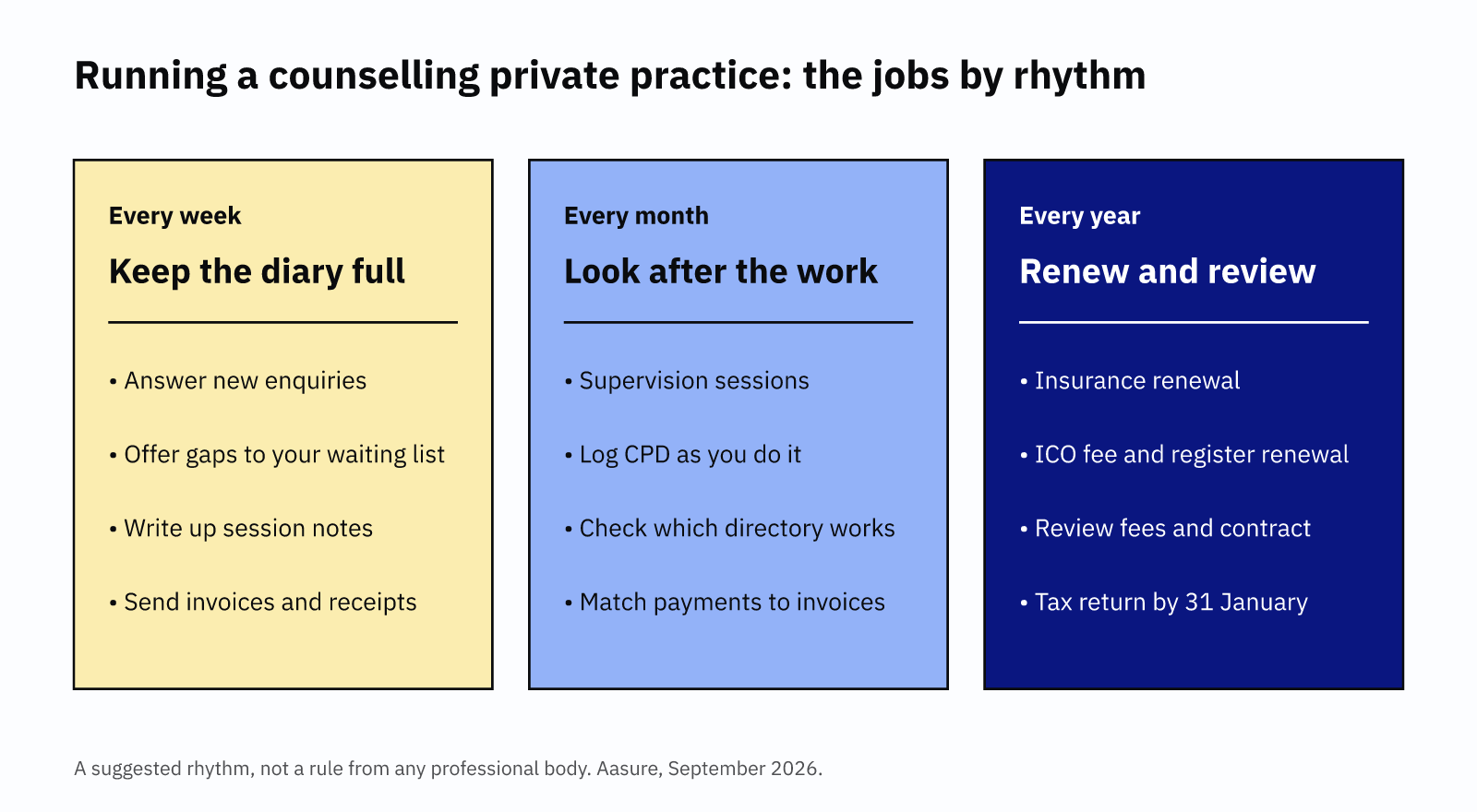
Filling the diary in a counselling private practice
Most new clients find a counsellor through a directory, a referral or a web search. So pick two or three routes and measure them. Ask every new client, "How did you find me?" Then note the answer. After six months, you will know which routes actually work.
Directories are the usual first stop, and their prices differ a lot. As of September 2026, these are the main options:
- BACP Therapist Directory. This costs £76 a year and allows up to six listings. However, only registered and accredited members can join. Individual and student members cannot.
- Psychology Today. A listing costs £19.95 a month after six free months, with no contract. So a full year after the trial comes to £239.40.
- Counselling Directory. Many counsellors use it too. Its site blocked our checks, though, so look up its current price before you join.
Referrals matter just as much. For example, tell your GP surgery, local charities and past colleagues when you have space. Meanwhile, keep a short waiting list for your counselling private practice. When a regular client ends, you can then offer the slot the same week.
Setting and raising your fees
In a counselling private practice, a fair fee covers your costs and matches your local market. For a benchmark, look at BACP's own figures. Its Client Ethics Manager says over half its directory listings charge £40 to £60 a session. The same article notes that many therapists offer reduced rates for people on low incomes.
Next, check the fee against your real costs. Supervision, insurance, room hire, directories and training all come out of it. On top of that, you are not paid for holidays or sick days. Our free real hourly rate calculator shows what you actually earn per hour worked. Many counsellors find the answer is lower than they thought.
Raising a fee is easier in two stages. First, charge new clients the new rate straight away. Then give existing clients written notice, for example two months. Some counsellors also keep long-standing clients on their old rate. Either way, say so in writing, because the fee is part of your contract.
A cancellation policy that fits the therapeutic relationship
In a counselling private practice, a cancellation policy protects your income. However, it also protects the work. Clients should know the rule before they need it. BACP's Sarah Millward puts it plainly. Clients should know what fees apply if they miss or cancel a session. She adds that a notice period of 24 hours, 48 hours or a week is usual.
So choose one notice period and apply it the same way every time. That consistency matters, because a missed session can carry clinical meaning. If you apply the rule calmly, you can explore the absence without arguing about money. Our guide to writing a no-show policy has wording you can adapt.
Be careful with block booking in a counselling private practice, though. In the same article, BACP warns that some people may see prepaying for many sessions as unethical. In fact, it can benefit the therapist more than the client. If you do take payment upfront, your contract should say what happens to unused sessions.
Contracting for a counselling private practice
A written contract is the backbone of a counselling private practice. The BACP Ethical Framework, clause 31, asks members to contract with clients about the terms of their service. It also asks for terms "easily understood by the client". So write in plain English, not legal language.
- Fee and payment. How much, when it is due and how to pay.
- Cancellations. Your notice period, and what a missed session costs.
- Confidentiality. What stays private, and the limits, such as risk of serious harm.
- Notes. Whether you keep them, for how long and how you store them.
- Contact between sessions. Whether clients can message you, and when you reply.
- Breaks and endings. Your holidays, and how either of you can end the work.
- If you cannot continue. Who contacts clients if you fall ill or die.
Review the contract once a year, for example when you renew your membership. After that, send updated terms to every current client.
Notes and record keeping in a counselling private practice
Session notes are health data. The ICO lists "data concerning health" as special category data. That means you need an extra legal condition, called an Article 9 condition, to process it. It also means you should store notes securely, with encryption and passwords.
Most practitioners also need to pay the ICO a yearly fee. For a small practice, the tier 1 fee is £52, or £47 by direct debit. Our GDPR guide for private practice covers the rest.
How long should you keep notes? UK GDPR does not give a number. Instead, the ICO says to keep data no longer than you need it, and then review and delete it. Meanwhile, BACP points out that clients have three years to bring a complaint. So some members keep notes for at least three years after therapy ends.
Whatever period you choose, tell the client at the start. BACP's Sarah Millward says best practice is to explain three things before therapy begins. Those are whether you keep notes, how long you keep them and what happens to them.
Money records in a counselling private practice follow a different clock. GOV.UK says self-employed people must keep them for at least five years after the 31 January deadline. Therefore, keep invoices apart from clinical notes, and put nothing clinical on an invoice.
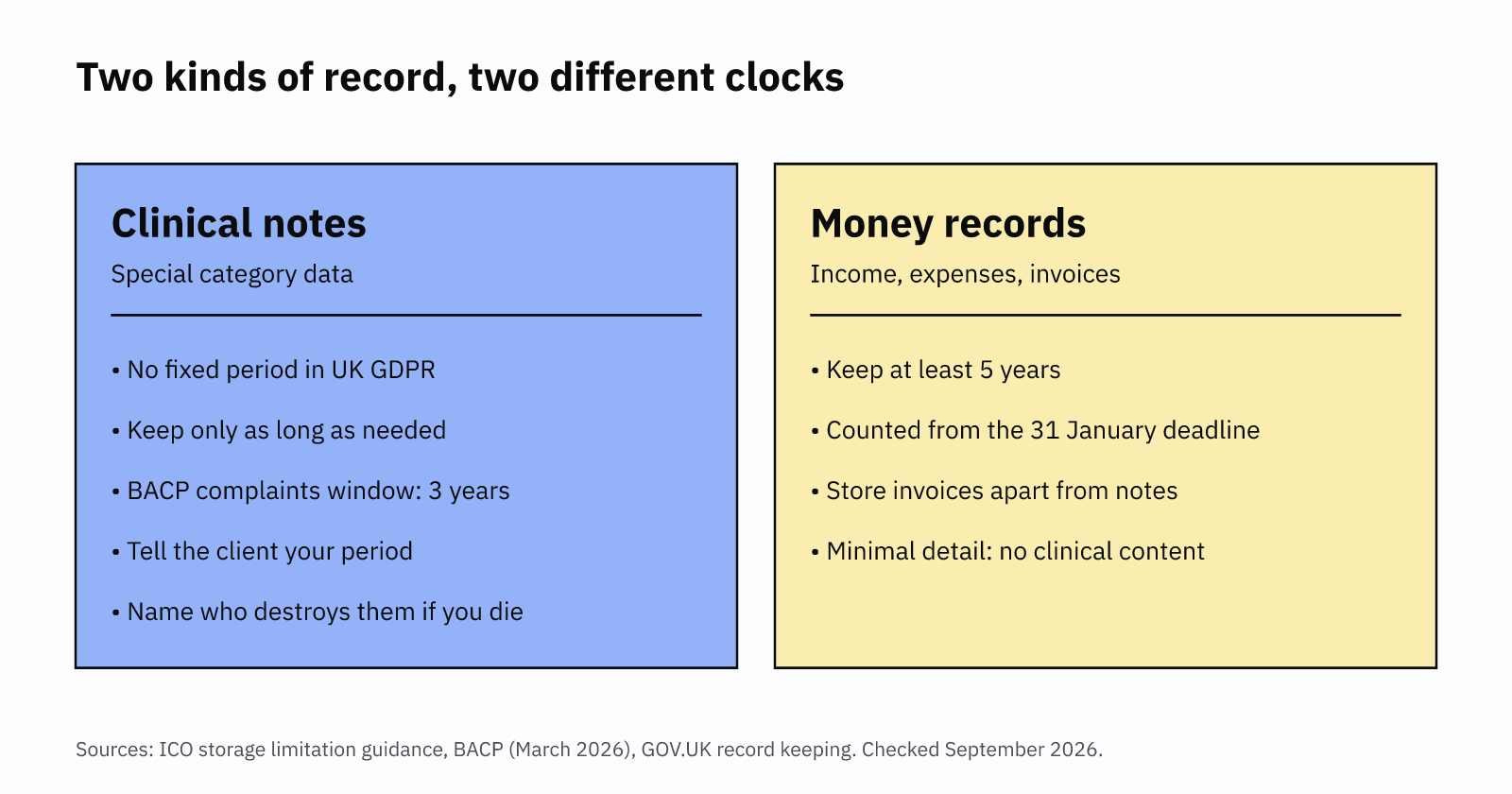
Finally, write a clinical will. BACP describes it as naming an executor, usually a fellow professional or your supervisor. That person then contacts clients and handles records if you cannot.
Supervision, CPD and insurance: what your register expects
Supervision is not optional in a counselling private practice. The BACP Ethical Framework says so in clause 60.
Supervision is essential to how practitioners sustain good practice throughout their working life.
However, the amount depends on your membership. BACP's guide to supervision sets a minimum of 1.5 hours a month for accredited members. For other registered members, there is no fixed number. Instead, you judge it by caseload and experience. You should also have a written contract with your supervisor.
CPD works the same way. BACP asks registered members to plan, do and record CPD, and to show how it changed their practice. In fact, BACP audits 1.5% of eligible renewing members every month. If BACP picks you, you get about six weeks to send your records. So log supervision and CPD as you go, not the night before.
Every counselling private practice also needs insurance. BACP registration asks for adequate, current and ongoing professional indemnity insurance. Similarly, UKCP asks members to hold appropriate indemnity insurance. Neither body sets a minimum amount of cover. So ask your insurer what suits your client group, and check it at every renewal.
Tax and Making Tax Digital for counsellors
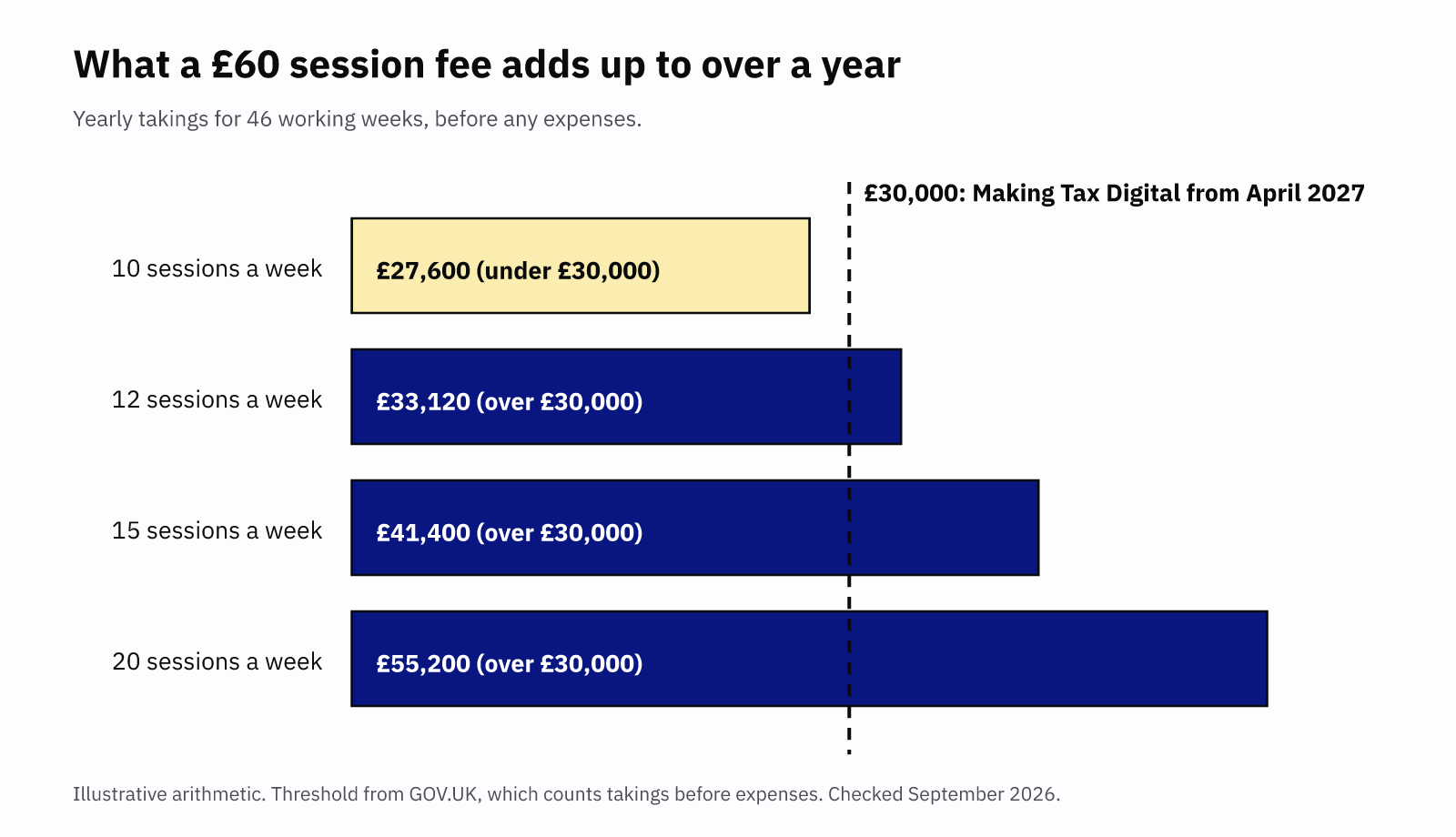
Most people running a counselling private practice are sole traders. That means you file a Self Assessment return each year. From 6 April 2027, however, Making Tax Digital adds quarterly updates. It applies once your qualifying income passes £30,000, based on your 2025/26 return.
That threshold is closer than it sounds. HMRC counts takings before expenses, not profit. For example, 12 clients a week at £60, over 46 weeks, comes to £33,120. That is over the line, even though your profit is much lower.
So start keeping digital records for your counselling private practice now. Our guide to Making Tax Digital for sole traders explains the deadlines. Then the free MTD Readiness Quiz gives you a likely start date.
Choosing software for a counselling private practice
Software will not fill the diary of a counselling private practice for you. Still, it can take repetitive jobs off your evenings. Look for four things: online booking, reminders, invoicing and secure client records. Also check where the provider stores data, because notes are special category data.
We compare the main options in our round-up of therapy practice management software. Some tools suit a clinic with a receptionist, while others suit one counsellor with one room. Aasure covers a solo counsellor on its Solo plan and a small team on Growth or Scale. Our page for therapists shows what it covers. To be clear, Aasure does not file your tax with HMRC. For that, you still need MTD-compatible software.
Common questions
How much should I charge for counselling in private practice?
Start from what local counsellors charge, then check the rate covers your real costs. BACP says more than half of its directory listings charge £40 to £60 per session. So a fee in that range is usual. However, your location, experience and modality can all move it.
How long should a counsellor keep client notes?
No law sets one fixed period. Instead, the ICO says to keep data only as long as you need it. BACP suggests some members keep notes for at least three years, because that is its complaints window. Whatever you choose, tell clients before therapy starts.
How much supervision does a counsellor in private practice need?
It depends on your membership. BACP accredited members need at least 1.5 hours a month. For other registered members, BACP sets no fixed number of hours. Even so, you must have appropriate supervision in place and keep a record of it.
Does Making Tax Digital apply to counsellors?
Yes, if you are self-employed and take over the threshold. From 6 April 2027, it covers sole traders with qualifying income over £30,000. That figure is your takings before expenses. So a counsellor seeing 12 clients a week at £60 is likely to be in.
Keep the admin out of the room.
Aasure puts booking, reminders, client records and email marketing in one place, on one flat monthly fee. There is no commission on your own clients.
Sign up